
Your Brain Learns From the Life You Live
Much of what we do every day happens without much thought. We reach for the phone. Sit in the same chair. Follow the same routine. It's simply how the brain works.
When a behaviour is repeated in the same setting, the brain gradually links that behaviour with the cues around it. Over time, it becomes easier to do again. This is one of the ways habits develop.
The brain isn't asking whether the routine is helping you become more alive. It's learning what's familiar. That's both the challenge and the opportunity. Because if repetition can strengthen habits that keep us stuck, it can also strengthen habits that help us keep growing.
Your Environment Quietly Shapes Your Day
Take a look around the room you're sitting in. What is it inviting you to do?
Pick up a book? Go for a walk? Call a friend? Or switch on the television and scroll through your phone?
Research suggests that we're more likely to choose what's visible, convenient and easy to access. That's why small changes to our surroundings can sometimes make healthy habits easier to begin.
Your environment doesn't determine your future. But it does influence the choices you practise most often. And over time, those small choices become part of the life you're living.
It's Easy to Keep Living the Same Life
One thing I've noticed about getting older is how easy it is to keep doing what we've always done. The same morning routine. The same shops. The same conversations. The same evenings.
There's comfort in that. But there's also a risk. If nothing changes, there's less that asks us to think differently, learn something new or see the world with fresh eyes.
Neuroscience offers a encouraging reminder. The brain doesn't stop learning because we've reached a certain age. Research shows it can continue adapting throughout life, even though some aspects of thinking naturally become slower.
So maybe the question isn't, "Is it too late?"
Maybe it's, "What am I still saying yes to?"
Keep Giving Your Brain Something to Learn
One of the most encouraging things about the brain is that it doesn't stop responding to experience. But it does need something to respond to.
If every day follows the same pattern, there are fewer opportunities to learn, adapt or look at the world in a different way. That doesn't mean you need to reinvent your life.
It might be as simple as taking a class, learning a new skill, exploring somewhere you've never been or having conversations that make you think. Research suggests that continuing to challenge yourself through meaningful learning helps engage brain networks involved in attention, memory and executive function throughout later life.
That's how I like to think about neuroplasticity. Not as constantly doing something extraordinary. But as continuing to say yes to experiences that help you keep growing.
Being Busy Isn't the Same as Being Alive
It's easy to fill a day without feeling fully engaged in it. You answer emails, run errands, scroll through your phone and before you know it, the day is over.
There's nothing wrong with those things. The question is whether they're the only things filling your days.
Life isn't just about staying busy. It's about staying curious, continuing to learn, creating, connecting and having something to look forward to. The brain doesn't just respond to activity. It responds to engagement with life.
So every now and then, ask yourself:
- What am I curious about?
- What am I still learning?
- What am I looking forward to?
Growing older doesn't mean slowing down your curiosity. It means continuing to give yourself reasons to stay engaged with life.
Relationships Give the Brain Something It Can't Create Alone
Some of the experiences that shape us most happen with other people. A conversation where you feel truly understood. Helping someone through a difficult time. Sharing a laugh with friends. Teaching what you've learned. Feeling like you belong.
These moments do more than make us feel good. They engage brain networks involved in emotion, motivation and social connection.
Research also shows that people who feel connected are more likely to stay active, keep learning, maintain healthy routines and reach out for support when they need it.
That's one reason relationships matter so much as we grow older. They don't just enrich our lives. They give the brain more reasons to stay engaged with life.
Your Environment Is More Than Your Home
Your environment isn't just the space you live in. It's your neighbourhood, the people around you, the places you go and even the time you spend online.
All of these influence your daily choices. Take your phone, for example. Does it encourage you to learn, connect and create? Or mostly distract you?
Our attention is one of the brain's most valuable resources. That's why it's worth designing an environment that makes the life you want to live easier to choose.
Small changes can create new experiences. If you want to practise gratitude, keep a notebook by the kettle and write down one good thing each day. If you want more adventure, make it a habit to visit somewhere new every month, even if it's close to home.
Sometimes, expanding your life doesn't mean travelling further. It simply means noticing more of the world that's already around you.
The People Around You Matter Too
When we think about our environment, it's easy to think only about our home. But it's much bigger than that. It's also the people you spend your time with.
Research consistently shows that strong social connections are linked with better physical and mental health as we age. But relationships do something else that's just as important. They keep our brains engaged.
A good conversation asks you to listen, remember, think, understand another person's perspective and sometimes even change your own.
So here's a question worth asking: Who helps me stay curious? Who encourages me to keep growing? Because the people around us don't just shape how we feel. They also shape how we think.
How Your Environment Shapes Your Brain as You Age
One of the most encouraging ideas in ageing research is cognitive reserve. Researchers use this term to explain why some people cope better with age-related changes in the brain than others.
Scientists are still learning exactly how cognitive reserve develops, but research suggests that a lifetime of learning, strong social connections and mentally engaging activities is associated with greater cognitive reserve.
There isn't one activity that builds cognitive reserve, and no single habit can prevent cognitive decline. Instead, the evidence points to the value of staying engaged with life over time. This is where your environment matters.
The people around you, the places you spend time, and the opportunities you have to learn, move and connect all influence how often you engage in these experiences.
Your environment won't determine how you age. But it can make it easier to choose the kinds of experiences that support an active, engaged life and better brain health as you grow older.
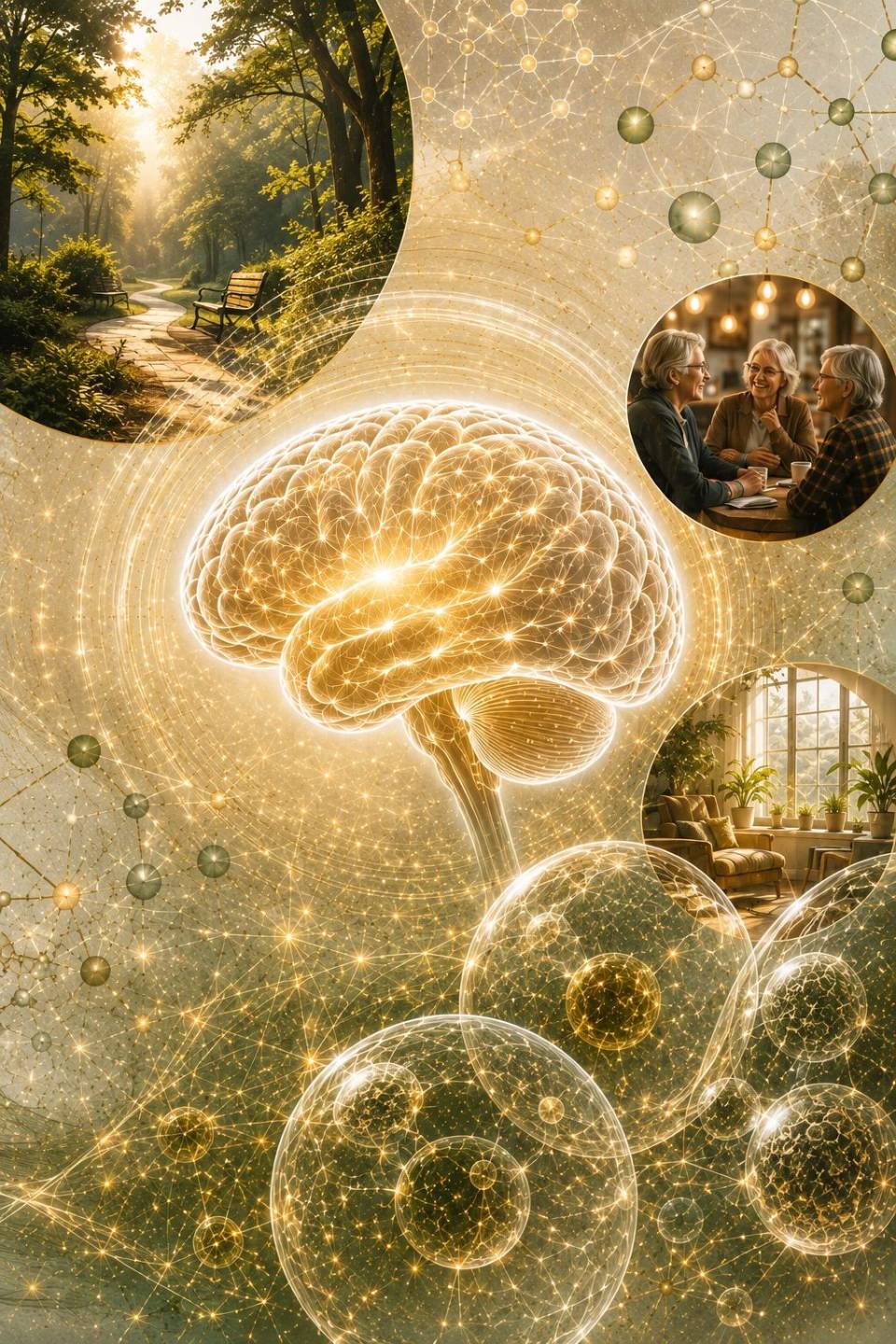
What does the science suggest?
The spaces we live in shape more than we realise.
Research suggests we're more likely to repeat behaviours that are easy, familiar and part of our everyday environment.
The encouraging news is that the brain continues to adapt throughout life. Learning, meaningful social connection and mentally engaging activities continue to keep important brain networks active as we age.
The takeaway is simple.
Your environment won't determine your future.
But it can make it easier to choose the experiences that keep you learning, growing and engaged with life.
Why does it matter for how we age?
Growing older isn't just about the passing of time.
It's also about the experiences we continue to have.
Research suggests that our environment can either make those experiences easier or harder to choose. A home, community or daily routine that encourages curiosity, movement, learning and connection gives us more opportunities to stay engaged with life.
That's why small changes matter. They can quietly support the life you're continuing to create.
How can I apply this in my own life?
Start small. Look for one thing your environment could do a little better.
Take a look around your home. What is it inviting you to do? What is it making easy? And what might it be making harder?
You don't need a complete makeover. Sometimes moving a chair, leaving a book on the table or putting your walking shoes by the door is enough to gently change your routine.
The goal isn't to rely on more willpower. It's to create an environment that quietly supports the life you want to live.
At Longevity Reimagined, we believe longevity is more than living longer.
At Longevity Reimagined, we see healthy ageing as more than avoiding decline. It's about continuing to participate in life. The science increasingly points in the same direction.
When we keep learning, creating, exploring, connecting and contributing, we repeatedly engage the brain's networks for attention, memory, motivation and learning.
These experiences won't stop ageing or guarantee perfect brain health. But they do give the brain what it was designed to respond to: experiences that are new, meaningful and engaging.
One of the most encouraging things neurosciences has shown us is that the brain remains adaptable throughout adulthood. The life you continue to live continues to shape the brain you carry into the future.
Key Research References
Meaning, Self-Reference & Memory
- Symons, C. S., & Johnson, B. T. (1997). The Self-Reference Effect in Memory: A Meta-Analysis. Psychological Bulletin, 121(3), 371–394.
- Gutchess, A. H., Kensinger, E. A., Yoon, C., & Schacter, D. L. (2007). Ageing and the Self-Reference Effect in Memory. Psychology and Aging.
Emotion and Memory
- McGaugh, J. L. (2004). The Amygdala Modulates the Consolidation of Memories of Emotionally Arousing Experiences. Annual Review of Neuroscience, 27, 1–28.
- Phelps, E. A. (2004). Human Emotion and Memory: Interactions of the Amygdala and Hippocampal Complex. Current Opinion in Neurobiology.
Novelty, Dopamine & Learning
- Bunzeck, N., & Düzel, E. (2006). Absolute Coding of Stimulus Novelty in the Human Substantia Nigra/VTA. Neuron.
- Kamiński, J., et al. (2018). Novelty-sensitive Dopaminergic Neurons Predict Successful Memory Formation in Humans. Proceedings of the National Academy of Sciences (PNAS).
Purpose and Cognitive Ageing
- Boyle, P. A., et al. (2010). Purpose in Life Is Associated with Reduced Risk of Incident Alzheimer's Disease and Mild Cognitive Impairment. Archives of General Psychiatry.
- Sutin, A. R., et al. (2021). Purpose in Life and Risk of Dementia: A Meta-analysis. Psychological Medicine.
Social Connection and the Brain
- Bhanji, J. P., & Delgado, M. R. (2014). Perceived Social Support Buffers the Negative Effects of Everyday Stress on Reward-related Neural Activity. Social Cognitive and Affective Neuroscience.
- Tzakis, N., et al. (2023). The Neural Basis of Social Reward. Neuroscience & Biobehavioral Reviews.
Awe and Self-Transcendence
- van Elk, M., et al. (2019). Neural Correlates of the Awe Experience. Human Brain Mapping.
Neuroplasticity Across Adulthood
- Park, D. C., & Bischof, G. N. (2013). The Aging Mind: Neuroplasticity in Response to Cognitive Training. Dialogues in Clinical Neuroscience.
- Lövdén, M., et al. (2010). Experience-Dependent Plasticity of White-Matter Microstructure Extends into Old Age. Neuropsychologia.