Your Brain Is Always Deciding What Matters
Your brain is taking in far more information than it can possibly process. So, it must decide what's worth paying attention to.
Research shows we're more likely to notice experiences that connect with our purposes, relationships, values or sense of who we are. Neuroscientists call this salience.
That's why the same experience can affect people so differently. One person might walk through a botanical garden and barely notice it. Another might leave feeling inspired.
The place hasn't changed. What changed is what it meant to them.
Your brain isn't just responding to what's happening around you. It's responding to what matters to you.
Meaning Helps Create Stronger Memories
Have you ever noticed how you can remember a conversation from years ago, but forget what you had for dinner last Tuesday?
One reason is that the brain remembers experiences that feel personally meaningful. Psychologists call this the self-reference effect. Research shows we're more likely to remember information when it connects to our own lives.
When something becomes part of your story, brain regions involved in self-reflection and autobiographical memory become more active. Instead of simply recording what happened, the brain is asking: "What does this mean for me?"
The more personal the experience feels, the more likely it is to stay with you. That's one reason meaningful moments often become the memories we carry for years.
Emotion Signals What Matters
Not every meaningful experience is joyful. Some of the moments that stay with us most are filled with love, gratitude or awe. Others come through loss, challenge or change.
Emotion helps the brain recognise that something is important. When an experience carries emotional significance, the amygdala works with the hippocampus to strengthen how that memory is stored.
That doesn't mean every emotional moment becomes a lasting memory, or that only positive experiences matter. What seems to matter most is when emotion and personal meaning come together.
That's often why we remember a simple conversation, a kind gesture or a life-changing moment years later. Not because it was dramatic. Because it meant something to us.
The Brain Learns Best When Learning Feels Meaningful
Our brains are naturally drawn to new experiences. When something is new or unexpected, learning and memory systems become more active, including the hippocampus and dopamine-producing regions of the brain.
But novelty on its own doesn't always last. Trying something new just for the sake of it can quickly lose its appeal. What makes a bigger difference is why it matters to you.
Maybe you're learning Italian because you've always wanted to travel through Tuscany. You start painting because it's a creative part of the next chapter of your life. Or you take up astronomy because looking at the night sky fills you with wonder.
The activity isn't the most important part. The meaning behind it is.
When curiosity, purpose and personal interest come together, the brain has a much stronger reason to stay engaged, keep learning and build lasting memories.
Purpose Keeps the Brain Engaged
Having something to look forward to matters.
The brain's reward system helps keep us motivated to work towards goals that feel meaningful. Whether it's learning a new skill, volunteering, starting a business or planning a trip, having a sense of purpose gives the brain a reason to stay engaged.
Research consistently shows that people with a stronger sense of purpose tend to experience healthier cognitive ageing and are less likely to develop cognitive decline.
That doesn't mean purpose prevents dementia. Most of this research is observational, so it can't prove cause and effect.
What it does suggest is that people with a strong sense of purpose are often more likely to keep learning, stay socially connected, be physically active and continue doing the things that support brain health.
Purpose isn't just something we feel. It's something we continue to live.
Relationships Give the Brain Something It Can't Create Alone
Some of the experiences that shape us most happen with other people. A conversation where you feel truly understood. Helping someone through a difficult time. Sharing a laugh with friends. Teaching what you've learned. Feeling like you belong.
These moments do more than make us feel good. They engage brain networks involved in emotion, motivation and social connection.
Research also shows that people who feel connected are more likely to stay active, keep learning, maintain healthy routines and reach out for support when they need it.
That's one reason relationships matter so much as we grow older. They don't just enrich our lives. They give the brain more reasons to stay engaged with life.
Meaning Changes the Story We Tell Ourselves
We all have a story we tell ourselves about who we are. The interesting thing is, that story isn't fixed. It keeps changing as we move through life.
Sometimes one conversation gives us confidence we didn't know we had. Sometimes a setback becomes the start of a completely new chapter. Sometimes letting go of one identity makes room for another.
Neuroscience shows that many of the brain networks we use to remember our past are the same ones we use to imagine our future. That means we're not only remembering our lives. We're continually rewriting what they mean. A moment that once felt like failure can, with time, become the experience that changed everything. That's one of the most hopeful things about growing older. The meaning of our life isn't finished. It continues to evolve with us.
Feeling More Alive May Be Part of Living well as we age
What does the science suggest?
Research suggests the brain pays more attention to experiences that truly matter to us.
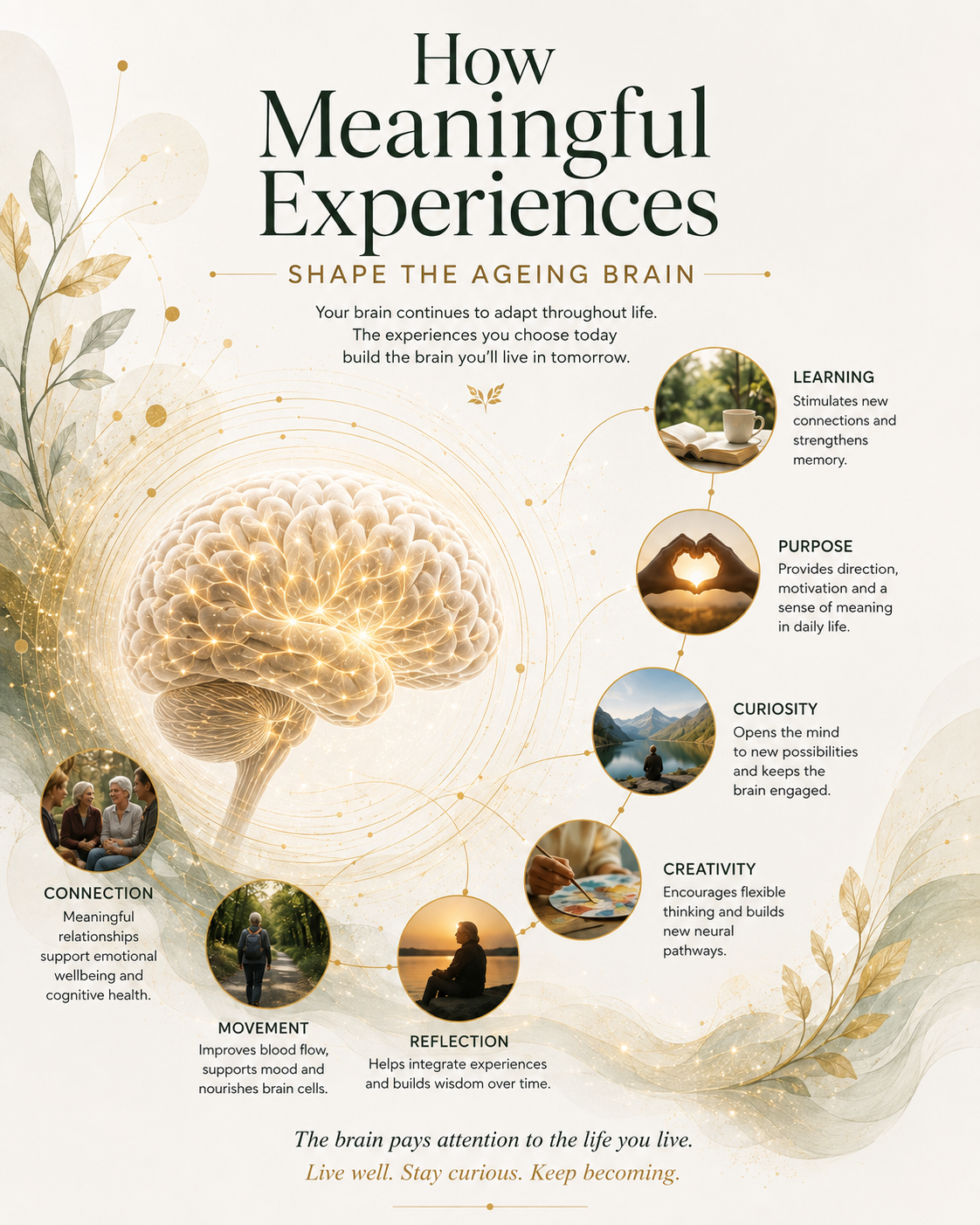
When we stay curious, learn something new, build relationships or pursue a sense of purpose, we engage brain networks involved in attention, memory, motivation and learning. Studies also suggest that people with a stronger sense of purpose and connection often experience better cognitive outcomes as they age.
Meaningful experiences won't stop ageing, but they do give the brain more reasons to stay engaged, adaptable and ready to keep growing.
Why does it matter for how we age?
The way we live today helps shape how we experience tomorrow.
Research suggests that when we stay curious, keep learning, nurture relationships and have a sense of purpose, we give the brain meaningful reasons to stay engaged.
These experiences won't stop ageing or guarantee perfect brain health. But they do help the brain keep adapting throughout life.
Growing older isn't just about adding more years.
It's about continuing to find new ways to feel alive.
How can I apply this in my own life?
Start with what interests you.
Learn something new. Spend time with people who matter. Try something creative. Go somewhere different.
You don't have to do something extraordinary.
Research suggests it's these meaningful experiences that help keep the brain engaged and ready to learn throughout life.
Small experiences, repeated over time, can make a real difference.
At Longevity Reimagined, we believe longevity is more than living longer.
At Longevity Reimagined, we see healthy ageing as more than avoiding decline. It's about continuing to participate in life. The science increasingly points in the same direction.
When we keep learning, creating, exploring, connecting and contributing, we repeatedly engage the brain's networks for attention, memory, motivation and learning.
These experiences won't stop ageing or guarantee perfect brain health. But they do give the brain what it was designed to respond to: experiences that are new, meaningful and engaging.
One of the most encouraging things neurosciences has shown us is that the brain remains adaptable throughout adulthood. The life you continue to live continues to shape the brain you carry into the future.
Key Research References
Meaning, Self-Reference & Memory
- Symons, C. S., & Johnson, B. T. (1997). The Self-Reference Effect in Memory: A Meta-Analysis. Psychological Bulletin, 121(3), 371–394.
- Gutchess, A. H., Kensinger, E. A., Yoon, C., & Schacter, D. L. (2007). Ageing and the Self-Reference Effect in Memory. Psychology and Aging.
Emotion and Memory
- McGaugh, J. L. (2004). The Amygdala Modulates the Consolidation of Memories of Emotionally Arousing Experiences. Annual Review of Neuroscience, 27, 1–28.
- Phelps, E. A. (2004). Human Emotion and Memory: Interactions of the Amygdala and Hippocampal Complex. Current Opinion in Neurobiology.
Novelty, Dopamine & Learning
- Bunzeck, N., & Düzel, E. (2006). Absolute Coding of Stimulus Novelty in the Human Substantia Nigra/VTA. Neuron.
- Kamiński, J., et al. (2018). Novelty-sensitive Dopaminergic Neurons Predict Successful Memory Formation in Humans. Proceedings of the National Academy of Sciences (PNAS).
Purpose and Cognitive Ageing
- Boyle, P. A., et al. (2010). Purpose in Life Is Associated with Reduced Risk of Incident Alzheimer's Disease and Mild Cognitive Impairment. Archives of General Psychiatry.
- Sutin, A. R., et al. (2021). Purpose in Life and Risk of Dementia: A Meta-analysis. Psychological Medicine.
Social Connection and the Brain
- Bhanji, J. P., & Delgado, M. R. (2014). Perceived Social Support Buffers the Negative Effects of Everyday Stress on Reward-related Neural Activity. Social Cognitive and Affective Neuroscience.
- Tzakis, N., et al. (2023). The Neural Basis of Social Reward. Neuroscience & Biobehavioral Reviews.
Awe and Self-Transcendence
- van Elk, M., et al. (2019). Neural Correlates of the Awe Experience. Human Brain Mapping.
Neuroplasticity Across Adulthood
- Park, D. C., & Bischof, G. N. (2013). The Aging Mind: Neuroplasticity in Response to Cognitive Training. Dialogues in Clinical Neuroscience.
- Lövdén, M., et al. (2010). Experience-Dependent Plasticity of White-Matter Microstructure Extends into Old Age. Neuropsychologia.